Showing posts with label Non-Royal. Show all posts

Thursday, January 9, 2014

Tiara Thursday: The Cartier Onyx Tree Kokoshnik

The Cartier Onyx Tree Kokoshnik
We don't see onyx that often in today's royal jewels, though it was long a staple of mourning jewelry. But in this tiara the black material shines, depicting an Art Deco tree with branches sprawling across a diamond background in a platinum setting. The tiara, made by Cartier Paris in 1914, also features pearls studding the top of its kokoshnik shape (kokoshniks are traditional Russian headdresses) and touches of black enamel. The tree is fascinating here, too - nature motifs are incredibly common in the tiara world, but this stylized version is a uniquely complete depiction, trunk and all. The combo of the tree and the black onyx gives this diadem sort of an Evil Queen appeal, don't you think? Just me? (That's a compliment, by the way. The Evil Queen always gets the best wardrobe.)
Center detail of the tiara; a clutch with the tiara's image carried by Charlotte Casiraghi; the Cartier exhibit ad
The tiara exists in the Cartier world as a showpiece, really, a stunning example of the craftsmanship and Art Deco styling of the renowned firm. I have not seen it in use (though if you have an example, feel free to comment). It's a cover girl tiara, its image adorning book covers, promotional materials, even purses. Currently, it's being used in promotions for a massive Cartier exhibit in Paris.

Video: The Cartier exhibit
The Cartier: Style and History exhibition at the Grand Palais, Paris, runs until February 16, 2014. Hundreds of Cartier works of art are on display, including some pieces with royal connections. Queen Elizabeth II has loaned out the Williamson Diamond Brooch and the Halo Scroll Tiara; Monaco's princely family has loaned pieces including the Cartier Pearl Drop Tiara, the brooches from the Bains de Mer Tiara, a diamond necklace, and Princess Grace's engagement ring; the bandeau tiara that belonged to Belgium's Queen Elisabeth is out for show, plus pieces from the collection of the Duchess of Windsor, and much much more. If you can get there, don't miss it! 

How do you rate this tree tiara?

P.S.: Our new Royal Outfit of the Day series runs on Thursdays too, so keep reading for the second post!

Photos: Cartier/Getty Images

Thursday, January 2, 2014

Royal Fashion Awards: New Year, New Sparkle

And so it is time, once again, to ring in a new year of royal splendor in the way we always do: with tiaras! The Danish royal family wastes no time busting out their finery, holding the first of a series of New Year's events with a banquet on January 1. It's time for tiaras, gowns, uniforms, and the extra fancy collars from the Order of the Elephant:

Video: The royal family arrives

Best Repeated Variety
Queen Margrethe
The Queen can be counted on to repeat a gown for the event, but she's the only one of the three ladies here that changes up her tiara choice from year to year, so there's that. This year she repeated a favorite apple green gown which is quite flattering and paired it with her traditional Yeti pelt fur wrap and the Danish Emerald Parure from the crown jewels. She also wore this combo in 2011 for the same event.

Most Stretched Repeat
Crown Princess Mary
The banquet has become Mary's yearly opportunity to display just how creative she can get with the many pieces of the Danish Ruby Parure - and normally, I love it. But...maybe sticking the brooch on a piece of velvet and calling it a choker is stretching it just a tad, hmm? The choker is a new incarnation of this burgundy velvet dress, which is making its third appearance at the event and has been revamped from its original maternity form.

Best in New
Princess Marie
Making sure we don't drown in repeated gowns, Marie's here to save the day in a new number with a printed peplum top and a solid skirt with a train. The way she's pinned on her collar is just lovely, but I'm missing the small portrait brooch of Queen Margrethe (as worn by Mary) - we've seen Marie wear the honor previously, but not tonight. A picky request, though, from a completely elegant appearance. She is wearing her regular diamond floral tiara.

And an Honorable Mention to...
Helle Thorning-Schmidt
I know basically two things about Denmark's prime minister: she likes a good selfie, and she knows exactly how to dress herself for gala events when she's thrown in with tiara-wearing ladies. All politics aside, she's my tiara-less best dressed for the evening. I mean, this is just gorgeous.

There are two additional receptions in Denmark to be held yet (neither with tiaras, but still fancy court dress).

UPDATE: And here's the sparkly event in Japan, in the video below!
For the second year in a row, Empress Michiko has chosen not to wear a tiara, I believe for medical reasons (extra weight on the head can be troublesome if you have a back issues and things like that). At the beginning, we see the Crown Princess arrive in the pearl-tipped diamond fringe tiara. She does not appear at the audience itself, so the arrival is all we get. The rest of the imperial ladies are sporting their individual tiaras.

Who wins your best dressed award?

Photos: DR1/BilledBladet/Scanpix

Friday, October 25, 2013

Tiara Thursday (on a Friday): The Londonderry Tiara

A day late, because BABIES, but here nevertheless is your weekly dose of sparkle:
The Londonderry Tiara
The Londonderry Tiara, you'll not be surprised to learn, is the headline jewel in the rather magnificent collection of the Londonderry family, headed by the Marquess of Londonderry. Several members of the family have played significant roles in politics and British high society throughout history, and as the family gems have been worn by one Marchioness after another to one important event after another, the jewels have gained a fame of their own.
Marchioness Frances Anne (left) and Marchioness Theresa (right, wearing the tiara)
The first influential Lady Londonderry to play a role in this tiara's story is Frances Anne (1800-1865), wife of the third Marquess. In 1854, she commissioned Garrard to dismantle existing Londonderry pieces (a waistband or belt, some of the insignia of the Order of the Garter that belonged to the second Marquess, plus more) and create a new parure. This tiara was part of that new set. It is made from 1,141 diamonds, including some fine Golconda and Brazilian stones, in silver settings mounted in gold. The diamonds – 482.5 carats in all - form a tiara that makes a near complete circle and takes the shape of swags connecting a series of palm motifs. The original estimate from Garrard, which is quoted in Diana Scarisbrick’s Ancestral Jewels, notes that the tiara is to “divide as comb and brooches”, but the diadem has been changed plenty over the years. Initially, the centers of the tiara motifs were pearls; the family has an impressive set of pearls to their name, some of which could be mounted on top of the tiara for a taller look. The centers of the tiara motifs are now diamonds and are mounted to tremble on springs for maximum sparkle.
Marchioness Theresa. On the left, she attends the Devonshire House Ball in 1897 decked out as Empress Maria Theresa of Austria with a gown copied from a portrait and covered in her own jewels, including a crown of real diamonds specially made up for the occasion behind the tiara. On the right, she adds the pearls to the tiara for the coronation of Edward VII in 1902.
Both versions of the tiara - with and without pearls on top - were worn to great effect by Theresa (1856-1919), wife of the sixth Marquess. She had a forceful personality and plenty of influence to exert; she was a renowned society hostess and used the full force of the family jewel collection to get the job done (part of E.F. Benson’s description of her, as quoted in Geoffrey Munn’s Tiaras: A History of Splendour: “She reveled in personal splendor, she frankly and unmitigatedly enjoyed standing at the head of her stairs… with the ‘family fender’ as she called that nice diamond crown on her most comely head.”). Her use of that family fender at many important occasions is well recorded, including the time it slipped off her head and fell in the toilet at the coronation of Edward VII (a predicament that came to light when her extended time in the loo became conspicuous and she had to call for assistance; the tiara was rescued by a pair of forceps).
Marchioness Edith with the tiara in portrait (left) and for the 1937 coronation (center). Note the other family jewelry shown here and above, including the diamond Latin cross on Theresa, plus the famous Londonderry pearls and the enormous diamond stomacher on both Edith and Theresa. Right: the tiara on display at the V&A.
This collection became so well known that when Edith (1878-1959), wife of the seventh Marquess and another influential Lady Londonderry, was criticized for bringing the gems out again after World War I, the Illustrated London News jumped to her defense. The publication named the “superb and plenteous” Londonderry jewels “a heritage, and one in which Britishers all round take a vicarious pride.” This tiara, along with other treasures, is still with the family. In recent years they've shared the bounty by allowing the tiara (as well as their fantastic amethysts) to be exhibited at the Victoria & Albert Museum in London. I've seen it there, and it is enchanting; it's one that I forget I love until I see it again, and then I feel the sudden need to rework my list of favorites.

Is it a favorite for you?

Photos: Geoffrey Munn/Londonderry family/Wikipedia/NPG/Lafayette/V&A

Thursday, October 10, 2013

Tiara Thursday: Archduchess Isabella's Peridot and Diamond Tiara

Archduchess Isabella's Peridot and Diamond Tiara
Today's tiara received a fair bit of attention during our round up last week of tiaras which venture beyond standard featured stones. And this is very much an interesting and uncommon stone for a tiara: peridot, a green option with a range of shades from rather pale and watery to an intense olive or even lime green. These particular peridots are quite fine, with good purity, huge size, and a deep olive color. There are five peridot stones in the tiara, each surrounded by a scrolling foliate diamond frame. The tiara is part of a parure which includes a set of earrings, a large brooch (or devant de corsage), and a necklace; the necklace includes seven drops which can be removed and mounted upright on the tiara.
Archduchess Isabella
The tiara dates from the 1820s and is attributed to Kochert, court jeweler to the sprawling Habsburg family in Austria. It's said to have originally been made for Princess Henrietta of Nassau-Weilburg (1797-1829), who was the wife of Archduke Charles, Duke of Teschen. But the tiara is most strongly associated with Princess Isabella of Croÿ (1856-1931), who married Archduke Friedrich, grandson of Henrietta and Charles and a successor to the Duke of Teschen title. It is on Archduchess Isabella that we have our first evidence of the tiara in use.
The necklace, earrings, and brooch from the parure
The parure has been through a few sales since Archduchess Isabella's time. The first came after the 1936 death of her husband, Archduke Friedrich; in 1937, the set was sold to Count Johannes Coudenhove-Kalergi (1893-1965) and his wife Countess Lilly. The jewels ended up in the United States, eventually passing to their daughter, Marina. Countess Marina lived a life apart from her noble roots, and the jewels stayed tucked away inconspicously in a bank safety deposit box for decades. When she died in 2000, her estate administrators were shocked to find that the jewels from her mother she had mentioned turned out to be this exquisite set with royal provenance, as verified by Sotheby's.
Joan Rivers, wearing the necklace and earrings
The jewels were auctioned by Sotheby's in 2001 and sold for around $400,000. They were bought by Fred Leighton, the jewelry firm well known for its celebrity connections, and the necklace and earrings were later loaned out to comedian and TV personality Joan Rivers for the 2004 Golden Globes ceremony. At some point, at least a part of the set was purchased by Lily Safra, as the earrings and brooch were placed on auction yet again in May 2012 when a selection of jewels from the philanthropist's collection were sold by Christie's for charity. I don't believe the whereabouts of the necklace and tiara are publicly known today.
The tiara with the necklace pendants attached
I'm not a big fan of peridot - these just aren't my favorite shades of green - but I do love seeing a tiara that makes an unusual stone choice. I love the variety, and I wish we saw more of such things on today's royal ladies.

Peridot tiaras: yes or no?

Photos: Sotheby's/Wikimedia Commons/Christies/WireImage

Thursday, October 3, 2013

Tiara Thursday: The Bagration Parure

The Bagration Parure Tiara
Today's tiara holds a stone we don't see often in diadems: the pink spinel. Spinels are interesting stones; the red ones are often confused for rubies (the famous Black Prince's Ruby and the Timur Ruby are both in fact spinels) and indeed there was a time when no distinction between ruby and red spinel was made in jewelry inventories. The pink versions showcased here are framed by diamonds and set in a valuable and old diamond structure. The tiara is highlighted by the pear-shaped spinels, which hang beneath diamond arches and sit on top of a scrolling diamond design studded with more spinels. The tiara's diamond base features oval spinels. The tiara dates from the early 1800s and is attributed to J.B. Fossin, one of the jewelers who shaped the beginnings of the Chaumet firm. The full set includes the tiara, a matching hair comb, a necklace of six pink spinel and diamond plaques with several pendants, and a pair of pendant earrings.
The parure's necklace, earrings, and haircomb
The necklace and earrings are Russian-made and were later additions, dating from the 1870s. They were added by subsequent owners, but the tiara originated with Catherine Bagration (1783-1857). Raised at the Russian imperial court, she married Peter Ivanovitch Bagration, a general in the Russian army and a prince from the Georgian royal Bagration family. She was an intriguing figure - her Wikipedia page is worth a browse - and it was for her the tiara was made, or at least acquired, and for her it is named.
The current Duke and Duchess of Westminster, on their wedding day
The parure might have faded away, lost to history, but a modern sale placed it in a collection of note. The current Duke of Westminster purchased it for his fiancée, Natalia Phillips (who has Russian ancestory herself), and she wore it on their wedding day in October 1978. The set joins the rest of the tiaras in the Westminster collection, and though we don't often see them in use publicly, the family is generous in allowing them to be displayed and so on.
As I said a few weeks ago, the world needs more pink tiaras, and I like this one more every time I see it. The parure isn't just notable because of its stone, but because of its age - many tiaras of this age have been significantly changed since, if they are still in existence at all today. The addition of a hair comb in the set is hint enough, as they are rare inclusions today but were once staples of the great sets of jewels made when the French monarchy was at its most impressive.

Is this one a favorite for you?

Photos: Geoffrey Munn/Their Graces The Duke and Duchess of Westminster/Spokeo

Thursday, September 12, 2013

Tiara Thursday: The Chaumet Bourbon-Parma Tiara

The Chaumet Bourbon-Parma Tiara
This is one of those rare tiaras that has managed to become fairly well known despite the fact that it isn't owned by a reigning royal family, and wasn't ever really worn by a hugely famous royal. It does have royal roots, though, as it was initially a wedding gift for a royal marriage. The Belle Époque style tiara was made in 1919 by Joseph Chaumet and was bought by the Duchess of Doudeauville (some reports say it was the Duke). She gave it to her daughter, Hedwige de La Rochefoucauld (1896-1986), for her marriage to Prince Sixtus of Bourbon-Parma that same year. It has a base which alternates between sizes of diamond collets and a body of sprays of diamonds held by knife-edge platinum settings. The top has upright pear-shape diamonds and there are both round and pear-shape diamonds below.
The wedding of Sixtus and Hedwige (this tiara not included)
You might be tempted to relate the Bourbon-Parma name to the current crop of Bourbon-Parma relations that are still roaming around today's royal events, but Sixtus and his family were just one part of the enormous B-P family. Prince Sixtus was the son of Robert I, Duke of Parma and Maria Antonia of Portugal, the Duke's second wife. Robert fathered 24 children in his two marriages and his descendants include the Luxembourg royals (son Prince Félix of Bourbon-Parma married Grand Duchess Charlotte), the family of Empress Zita of Austria (who was another of Robert's children), the children of Princess Irene of the Netherlands (whose late husband was Carlos Hugo, Duke of Parma and grandson of Robert), and more.
Modeled by Sophie Marceau (left) and Stella Tennant (right)
This tiara did not stay in that huge family, though. It was ultimately reacquired by Chaumet, and if you were previously familiar with this tiara, your connection is likely thanks to the Chaumet ownership. It has appeared in ads, exhibitions, and on film: Valérie Lemercier wore it in Palais Royal! and a copy appeared on the head of Anne Hathaway in the Princess Diaries films.
Valérie Lemercier (left) and Anne Hathaway (right)
It's a good tiara to use for promotion, since the skill required to put this one together is evident. I think it looks best when worn, when the connections between the diamonds disappear and it takes on a delicate water drop look.

How do you rate this tiara?

Photos: Chaumet/Disney

Friday, June 28, 2013

Readers' Ultimate Tiaras: Pick Your Pearls!

Pearls are a staple in a royal jewel vault, don't you agree? Most of the major royal collections have at least one pearl tiara at their disposal, and many have multiple options. Obviously, special space in your ultimate tiara collection should be devoted to pearls - two spaces, to be exact.

Pick your ultimate pearl drop tiara! 

AND 

Pick your ultimate standard pearl tiara!

Yes, we have two spots to pick this time around, so let's get to it. I'm splitting this into two distinct categories: pearl drops and just, you know, regular pearl tiaras. (By the way, there are oodles of links here - they will take you either to an entry on this blog with more info, or to a photo of the tiara in use.)


Choice #1: Dangling Pearl Drop

Pearl drop tiaras are defined here as those with dangling pearl drops. It's quite a popular tiara design, these pearl pendants swinging from diamond frameworks, with plenty of examples to pick from.

The British collection offers two prominent examples.

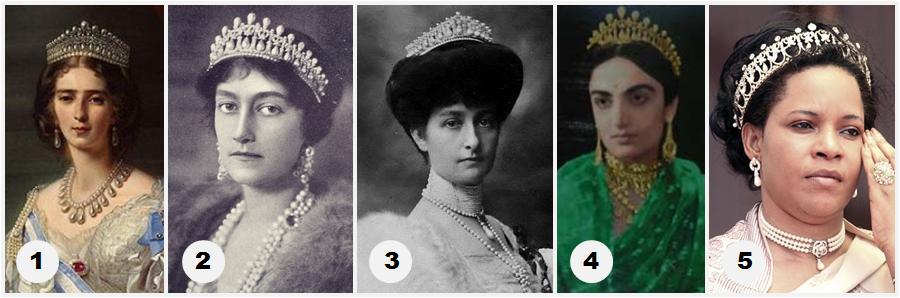
The Cambridge Lover's Knot was originally made as a replica of another tiara. It shouldn't be a surprise, then, to learn that there are multiple lover's knot tiaras out there with close to identical designs.
1. The Yusupova Lover's Knot Tiara, worn by Princess Tatiana Alexandrovna Yusupova
2. The Bavarian Lover's Knot Tiara, worn by Antonia, Crown Princess of Bavaria
3. The Saxony Lover's Knot Tiara, worn by Princess Maria Immaculata of Saxony
4.The Patiala Lovers Knot Tiara, worn by Rajmata Mohinder Kaur of Patiala
5. The Toro Lover's Knot Tiara, worn by Queen Best, mother of the King of Toro

Plus, drop pearl tiaras come in all kinds of other forms:
1. The Pearl Poiré Tiara, from Denmark
3. Alexandra Feodorovna's Pearl Drop Tiara, sold to the Duchess of Marlborough and then to Imelda Marcos, who apparently had it dismantled
5. The Romanov Pearl Drop Tiara, also worn by Alexandra Feodorovna
6. A modern Cartier version with central feather
7. Princess Anastasia of Greece's Cartier Tiara, with drop pearls and diamonds
9. An option apparently from Prussian royalty
And there are more out there, of course.


Choice #2: Standard Pearl

Second, I'll ask you to choose a regular pearl tiara - one that doesn't include dangling drops, but does include pretty much whatever else you like.

Upright drop pearls are always popular.
1. The Ancona Tiara, from Italy
4. The Antique Pearl Tiara, from the Netherlands
5. A pearl-topped fringe from the Romanov collection
7. The Württemberg Ornate Pearl Tiara, from the Netherlands
8. Queen Maud's Pearl and Diamond Tiara, from Norway, also available in a smaller pearl form

Round pearls work as toppers, too.
1. The Cartier Loop Tiara, from Spain
2. The Kent Festoon Tiara, from Britain
6. The Lotus Flower Tiara, from Britain
7. King Olav's Gift Tiara, from Norway

Or you can just incorporate them any which way you please.
2. The Rosebery Tiara, formerly in the collection of the Westminsters but recently sold
4. The Mountbatten Star Tiara, from the Mountbatten family
5. The Pearl Button Tiara, from the Netherlands
8. The Ogilvy Tiara, from Britain

And seriously, that's just the tip of the iceberg.
I mean, this doesn't even include things that go beyond your standard diamond and pearl pairing, like the Cameo Tiara, or the Portland Sapphire Tiara, all of which are fair game if you like! But I'll leave you here.


For reference, here's how your Ultimate Tiara Collection is looking so far:

Ready to vote for your favorite?
-Vote for two tiaras in the comments, one for each category. (If you're mentioning multiple tiaras in your comment, indicate which two get your vote, or I will just count the first applicable two. One comment vote per person, please.)
-I will also count the number of "likes" or up arrows on those comments, so you can vote that way too.
-Non-royal tiaras and tiaras that no longer exist are fair game too.


Programming note: The blog is on vacation next week. (I'll still be posting at the Jewel Vault, where it will be a busy week for the Queen.) I will put up an open post on Monday for those of you that would like to chat while we're on hiatus so we can keep that separate from the voting, make it a little easier for me in the tallying stage. I'll leave this post open until Wednesday for voting.

UPDATE: Thanks for all your contributions, voting is now closed!

Photos: Sotheby's/Christie's/Geoffrey Munn/Getty Images/India News/Scanpix

Monday, June 24, 2013

Weekly Royal Fashion Awards: June 16-22, and More

Best of the Week
Little bit of this, little bit of that...
Letizia at a meeting and at a mass to commemorate the 100th anniversary of the birth of Felipe's grandfather; Mathilde at an awards ceremony; Mette-Marit and Haakon hosting a dinner; Máxima on more province visits
Some of you were disappointed in a relatively tame Ascot showing last week; I was disappointed in a tame showing from everyone else in our regular cast of characters! This isn't everything, but it is the only things that held my attention: Letizia having some summer fun with color and in her proper princess best, Mathilde in a lovely print, Mette-Marit shaking up her hairdo, and Máxima in more hats-n'-jewels (and sharing a colorful thought with Charlotte Casiraghi in Giambattista Valli - there's two royals I never thought would end up in a sartorial comparison).

In other news, Sunday was National Day in Luxembourg!
L to R: Princess Tessy, Prince Louis, Princess Alexandra, the Hereditary Grand Duchess, the Hereditary Grand Duke, the Grand Duchess, the Grand Duke
A highlight of the celebrations is the Te Deum, for which the family gets all hatted up. This year, Alexandra wore Natan, Stéphanie was in Weill, and Maria Teresa sported Armani (these courtesy of Luxarazzi, where you can satisfy all your National Day needs). The highlight? MT wore some amethysts. Not terribly enchanted with the rest, I'm afraid. In the evening, there were tiaras - and more amethysts:
Maria Teresa wore the Belgian Scroll Tiara and her repeated Elie Saab gown, and Stéphanie wore an amethyst bandeau not seen in quite some time, which is delightful!

Judging by my inbox, though, there's a different tiara entirely that many of you are quite concerned about. Over the weekend Lady Melissa Percy, daughter of the Duke and Duchess of Northumberland, married Thomas van Straubenzee, longtime friend of Princes William and Harry, in what has repeatedly been billed as the society wedding of the year. The wedding pulled in a whole mess of well-known guests, but none upstaged the bride - and she made sure of that by her choice of headgear alone.

Video: News report on the wedding
Lady Melissa wore a large scrolling diamond tiara with a base of huge round diamonds. The tiara comes from the Percy family collection, and was worn to the coronation of Elizabeth II in 1953 by the then-Duchess, who was the bride's grandmother (she can be seen in the top pictures at this link). You could say that this was a secondary tiara in the collection, though, as the more important piece was the strawberry leaf coronet which included diamonds from a sword given to the third Duke by King George IV. It was worn to the 1953 coronation by the then-Dowager Duchess, who was Mistress of the Robes to the Queen Mother, but the tiara was stolen in 1963 while she was bringing it home from the jeweler to wear for a state banquet.
This is not the same diamond tiara worn at a rakish angle by Lady Melissa's sister, Lady Katie Percy, for her 2011 wedding to Patrick Valentine, so clearly the family collection's still doing just fine. (The two brides do appear to be wearing the same diamond necklace.) You may think Melissa bit off more tiara than she could chew, but I heartily applaud her go big or go home attitude! What a gorgeous tiara we wouldn't have seen otherwise...

Who was your best dressed last week?

Photos: Getty Images/ANB/Siste/ANP/DutchPhotoPress/WENN/Charles Caratini/SIP/Cour grand-ducale/RTL

Friday, May 31, 2013

Readers' Ultimate Tiaras: Your Emerald Winner!

It was a close race to start, but one tiara won out over them all...

The Duchess of Angoulême's Emerald Tiara!
The French crown collection has been vindicated following its runner up position in your ruby vote: the Duchess of Angoulême's Emerald Tiara wins, its provenance, design, and history surpassing the fact that we don't actually know what it looks like in use.

Your runners up:
2. Queen Victoria's Emerald and Diamond Tiara, my own personal favorite, and the one that gave our winner the biggest competition.
3. Empress Joséphine's Emerald Tiara. Despite the fact that many of you don't like the top stone, this one did quite well for itself.
4. The Grand Duchess Vladimir Tiara, with emeralds, which has been a favorite in the past - but not so much, this time around.
5. The Harcourt Tiara, lesser-known, but with an intriguing design and shape.

Stay tuned for our next poll!

Photos: Louvre/Royal Collection/Getty Images/Corbis/Christie's

Thursday, May 9, 2013

Tiara Thursday: The French Crown Ruby Parure

Last week I threw a ruby tiara from the French crown jewels in as a possibility for the ruby category of your ultimate tiara collection. It drew quite a bit of interest, so let's elaborate - starting with the Duchess of Angoulême. She was Queen of France for only 20 minutes in her lifetime, but she stamped her influence on the French crown jewels nevertheless.
The Duchess of Angoulême (wearing a different tiara)
Marie Thérèse of France (1778-1851) was the oldest and only surviving child of King Louis XVI and Queen Marie Antoinette. While in exile following the French Revolution, she married her cousin, Louis Antoine, the Duke of Angoulême, and became known as the Duchess of Angoulême. When the Bourbons were returned to the throne (in 1814, and then again in 1815), Marie Therese's widowed and childless uncle Louis XVIII reigned; in 1824, he was succeeded by her father-in-law Charles X, who was also widowed by that time. Marie Thérèse the first lady of the family, and thus the prime user of these luxurious jewels.
Replicas of the tiara and crown from the original French crown ruby parure - made of garnets and white sapphires.
When Marie Thérèse returned to France, the crown jewels (which, in France and other countries, are not necessarily just coronation regalia) included a ruby and diamond parure made in 1811 by Maison Nitot for Empress Marie Louise (1791-1847), the second wife of Napoleon I. This was an extensive parure, including items you'd expect to see in a parure - a tiara, necklace, earrings, bracelets - but also items such as a crown and a belt. The set used nearly 400 rubies and more than 6,000 diamonds in all. The tiara and crown shown above are replicas of the originals made for Marie Louise; these are made of garnets and white sapphires and belong to Chaumet, the jewelry firm once known as Nitot. Click here to see more of the replica parure.
The French Crown Ruby Tiara, in the version made for the Duchess of Angoulême which is believed to be in existence today
Once he reclaimed the throne, Louis XVIII had the crown jewels redone in the Restoration style instead of the Empire style. In 1816, the ruby parure was remade to suit the Duchess of Angoulême by Pierre-Nicholas Menière. The design came from Menière's son-in-law, Evrard Bapst, and kept some of the features of the original Nitot parure. The new parure was just as extensive as the old, including both a larger tiara (shown in color above) of rubies set in scrolling diamond foliage and a smaller comb/tiara.
The parure as it was prior to its sale
Marie Thérèse came and went (after the abdication of Charles X, the Duke of Angoulême was king for about 20 minutes before he abdicated in favor of his nephew) and power in revolutionary France continued to change hands, but as state property the rubies managed to stay safe and sound in the treasury and were worn by Queen Marie-Amélie and Empress Eugénie after Marie Thérèse. They even remained in the design made for Marie Thérèse - Napoleon III and Eugénie had other pieces redesigned, but the rubies passed muster as they were. (Despite all this, I know of no representation of the tiara in use in its final form.) The parure was finally auctioned off along with much of the rest of the crown collection by the Third Republic in 1887.
Some pieces of the parure today, including the two bracelets on display at the Louvre, brooches, and the major necklace
The different pieces belonging to the crown ruby parure went in different directions following the sale, and some have popped up in subsequent sales here and there. The two bracelets were donated to the Louvre and have been on display there since 1973, but the rest of the rubies (tiara included) are in private collections. The tiara is said to be in the Niarchos collection. Some pieces may have been broken up; recently, a brooch made from part of the ruby belt came to auction. It would truly be a sight to see them all be assembled once again, but at this point that seems an impossible feat.

Voting for the ruby set is closed, and we'll have the winner and runners up next week. But I'll ask it anyway:

Does this meet your criteria for a great ruby tiara?

By the way...if you're thinking of a different tiara related to the Duchess of Angoulême...you should stay tuned.

Photos: Wikipedia/Chaumet/Christie's/Sotheby's/Louvre

Thursday, May 2, 2013

Readers' Ultimate Tiaras: Pick Your Ruby

Fresh off our month of Dutch features, it's time to focus your ultimate tiara collection on the stone the Dutch collection happens to be particularly rich in:

Pick your ultimate ruby tiara!

Rubies are up there with emeralds and sapphires as colored precious stones represented in many royal collections. They work well in natural interpretations like flowers and wreaths, but motifs are plentiful.

The Dutch collection, as if you need a reminder at this point. The Mellerio on the left above, the Peacock on the right. And you can throw in the ruby version of Queen Emma's Diamond Tiara, if you want.

QEII's collection is represented by the old Oriental Circlet, a Prince Albert special, and the new Burmese Ruby Tiara.

Wreath examples come from the Greek collection - the Greek Ruby Parure Tiara - and the Danish collection, with the Danish Ruby Parure. The Greek one has a twin in the Baden family.

More leaves come from the Strawberry Leaf Tiara - previously in Queen Victoria's collection, and previously including rubies though they were eventually removed - and the ruby version of Queen Fabiola's Spanish Wedding Gift Tiara.

There are particularly tall choices, too - the lotus flower tiara (above left) owned by Marie Alexandrovna, Duchess of Edinburgh (and since sold), and the Edward VII Ruby Tiara that belonged to Crown Princess Margaret of Sweden and is now worn by Queen Silvia.

From Monaco we have the Bains de Mer Tiara, and a probable loaner double row ruby tiara worn by Princess Grace. Spain also has a double row of rubies (which can also be worn as a single row tiara - very flexible) known as the Niarchos Rubies, which were a wedding gift to Queen Sofia.

France's crown jewels have a ruby parure complete with tiara to offer (above left), and Iran's crown jewels have at least two: one made for Princess Ashraf (right, above) and one with diamonds and pearls (right, below).

And finally, a few more interesting formats (clockwise from top left): the Württemberg ruby star tiara, a dense ruby tiara owned by Empress Elisabeth of Austria, the Milford Haven Ruby Tiara, and a dragonfly motif tiara we've seen on the Duchess of Castro.

As a reminder, here's what your ultimate tiara collection looks like so far:


Ready to vote for your favorite?
-Vote for one tiara in the comments. (If you're mentioning multiple tiaras in your comment, indicate which one gets your vote, or I will just count the first one.)
-I will also count the number of "likes" or up arrows on those comments, so you can vote that way too.
-Non-royal tiaras and tiaras that no longer exist are fair game too.

And a programming note: The blog returns on Tuesday!

UPDATE: Thanks for all your contributions, voting is now closed!

Photos: Getty Images/Corbis/Royal Collection/Geoffrey Munn/Jewelry Museum