Showing posts with label Portugal. Show all posts

Tuesday, September 13, 2011

Asiago International Awards for Philatelic Art


image

On July 17th, the 41st Asiago International Awards were held. UNPA  won the Best Stamp of 2010 award for 2 event sheets about human trafficking and the fight against child labour.

image

At the ceremony for the forty-first Asiago International Awards for Philatelic Art, held in Italy on 17 July, UNPA received the prize for "best stamps in the world" for 2010. The winning stamp sheets highlighted "Human Trafficking - Blue Heart Campaign (UNODC)"  by UNPA Vienna and "Against Child Labour (ILO and Geneva World)" by UNPA Geneva.

UNPA Vienna issued a special stamp sheet on the theme "human trafficking" on 5 February 2010. The Blue Heart Campaign is an awareness-raising initiative developed by UNODC to fight human trafficking and its impact on society. The campaign aims to inspire decision makers to effect change, as well as to encourage the involvement of all areas of society to help stop this crime. The campaign allows people to show solidarity with the victims of human trafficking by wearing the blue heart as an international symbol against this crime. The blue heart represents the sadness of those who are trafficked while reminding us of the cold-heartedness of those who buy and sell fellow human beings.

image

On 2 September 2010, UNPA Geneva issued a stamp sheet on the theme "child labour". The drawings featured on the stamps show the grim realities of exploited young people. The selected images are part of "Children's Views of Child Labour", a vast initiative promoted in 2009 by GenevaWorld in partnership with the International Labour Organization (ILO) and with the support of local volunteers to mark the tenth anniversary of the adoption of the ILO Convention concerning the Prohibition and Immediate Action for the Elimination of the Worst Forms of Child Labour.

The prize is given annually under the patronage of the President of Italy. The organizing Italian stamp collectors club, Sette Comuni, is one of the most well-known and respected stamp collectors clubs in Europe.

Awards won by other Postal administrations..

Portugal won the Tourism award for the Public Elevators series.

image

image

Hong Kong won the Ecology award for a souvenir sheet about the Development of Old Areas.

image

Greece won the Olympic Academy award for their Europa 2010 Children's book set.

image

Thursday, August 18, 2011

Pierre de Fermat's birthday celebrated in Google Doodle


image_thumb[8]

La Poste commemorated Pierre de Fermat's  400th birth anniversary on a postage stamp in 2001


Hi ! Just received a mail from Mr Anurag Pratap of Silvassa about this news with the postage stamp issued by French Post…I wish  to share it with the readers …Some might have noticed it in 17th August 2011 in Google Doodle ….Those who have not noticed, might like the stamp issued on great “Amateur Mathematician” !  Mathematics  is a wonderful theme for the lovers of this subject ! This is all in this Post…Have a Nice Time !

The birthday of Pierre de Fermat, the 17th century French lawyer famous for the so-called 'Fermat's Last Theorem' mathematical puzzle, was celebrated in a Google Doodle on 17th August 2011. Because Ferment did not spread his work through books and journals and he often did not provide any proof for his theorems he was referred to as an 'amateur' mathematician, but that the same time Fermat is also considered to be one of the two (the other being Rene Descartes) leading mathematicians of the first half of the 17th century. Pierre de Fermat died at the age of 63 on January 12, 1665 at Castres, France.

Google doodles have gained immense popularity over the past few years and the Google team has put out commemorative doodles on events ranging from news events, civic milestones, birthdays, death anniversaries and important dates in history. Google estimates it has created more than 900 doodles since 1998, with 270 of them running in 2010.

The Doodle of  Pierre de Fermat shows a blackboard with algebraic symbols on it, with the word "Google" faintly visible as though rubbed out earlier. The symbols read: xn + yn ≠ zn. If you hover your mouse over the Doodle, the pop-up text reads "I have discovered a truly marvelous proof of this theorem, which this doodle is too small to contain."

image

Pierre de Fermat, was born on 17 August 1601, 410 years ago. A lawyer at the Parlement of Toulouse and a gifted amateur mathematician, he made breakthroughs in several fields of calculus, probability, geometry and number theory, but is best known for a brief note he made in the margin of a book of arithmetic. His enigmatic aside set the scene for perhaps the greatest mathematical mystery of all time.

Read More….

New Stamp…

Joint Issue : Portugal - Thailand

 image_thumb4

Date of Issue : 20 July 2011

Diplomatic Relations : Portugal - Thailand


500 Years of the Arrival of the Portuguese to Siam and the Establishment of Diplomatic Relations

Five centuries of unbroken relations from 1511 to 2011 between Portugal, the oldest established nation in the West, and Thailand, the only Southeast Asian State ever to be colonized,  go far beyond simple trade contacts and are a unique case in the annals of international relations, with diplomatic, political, military, religious, cultural and sociological dimensions. The relationship from the very beginning was one between equal nation states.

 
In the former capital, Ayutthaya, where a Portuguese district with churches and a mixed Luso Thai population long existed, generations of naval pilots, soldiers, interpreters and doctors loyally served the Kings of Siam. From the 16th to the 18th Century, portuguese was the lingua franca, and it was here that the Portuguese introduced technology and the skills of military construction, as well as European pharmacology and medicine.


Sia, was closely connected to the Asian possessions of the Portuguese Crown and received large and important embassies from Portuguese centres such as Malacca, Macau and Goa, The relations between the two countries remained unaltered, even during the troubled times of the war of liberation led by King Taksin – whose personal guard was provided by Portuguese military men – and Rama I, who received important military assistance from the Portuguese Queen Dona Maria I, in 1796.


In 1820, Siam and Portugal signed the first written treaty of modern times, ensuring Siam’s full integration in to the international community. During the period of the major reforms that took place during  the 19th century and the  beginning of the 20th century, under the reign of Rama V and Rama VI, many Portuguese from Macau settled in Bangkok acting as advisors to the Siamese government. Unlike other foreigners, they became Siamese citizens and received Thai citizenship. The history of this old alliance is an eloquent and pioneering example of fruitful dialogue between civilizations.

Club News
image


PHILANIPPON – 2011
World stamp exhibition, Yokohama city, Japan
(28th July – 2nd August 2011)

Pradip Jain_thumb[3]_thumb[3] Pradeep Jain from Patna writes…

Participating in Philanippon 2011 as a booth holder representing India, Bhutan, Nepal and Sri Lanka was a very pleasant experience. Being my first visit to Japan, I was excited on one hand but anxious on the other given the unfamiliar culture, taste and preferences and above all difference in language.

( From L to R ) : Mr Pradip Jain, Mr AR Singhee (Jury ) Mr Tay Peng Hian, RDP President FIP, Mrs Singhee, Mrs Pramila Jain and Mr Praggya Kothari

Exhibition hall was well organised and perfectly laid out providing sufficient displays and space for the visitors. The end of the exhibition hall featured rows of collections of various categories. One side of the hall had space for postal operators and the other side for domestic and international dealers. My most memorable moment was watching kids
engrossed in various activities spread across the exhibition hall. Another Interesting feature of the Exhibition was the presence of various security printer international and domestic who were giving out special souvenirs.

Visitors at Mr Pradip Jain’s Booth

A special mention of Cartor Security printers - who had brought in their printing machine in the the exhibition hall. Visitors were provided hands-on demo and interesting souvenirs which was printed and perforated on spot was given as gift. Over the next few days as the crowd of stamp lovers increased, I am especially grateful to Japan Post for arranging a volunteer that provided assistance to us in the booth during the crucial hours of massive crowd.

Overall my experience of Phila Nippon, Japan post and Japan was of immense satisfaction. Starting from our arrival,hotel accommodation, exhibition and finally custom clearance and departure, I had never witnessed anything so smooth, well managed and professionally handled. In the face of great natural calamity faced by Japanese, organising an event of such magnitude with great efficiency is remarkable achievement in itself. My Heartiest gratitude to organizers of Phila Nippon and People of Japan for their services and hospitality which i shall carry with me for my life.

Sunday, January 17, 2010

Stamps on Five Senses & Braille


port 2 

Date of Issue - 2 October 2009

Hi ! Here are some very nice stamps issued by Portugal which feature the five senses. These stamps show the most innovative idea of the designer and Portugal Post that resulted in  this wonderful issue. The stamps issued on five senses are not common.So this issue is very innovative in design and idea both. My thanks to Mr Sundar L Bansal of New Delhi for today’s Post. The sixth stamp featuring Louis Braille celebrates 200th Anniversary of the Birth Louis Braill. The other five stamps reveal our five senses smell, touch, taste, vision and hearing.This is all for this Post…Till Next Post…Have a Nice Time !

port 1 

 port 4

 port 5

The brochure with Five senses

port 3port 6

 port 7 port 8 port 9

Senses

This issue – consisting of five stamps and a block with a sixth stamp – is a consequence of a proposal made by the Universal Postal Union to celebrate the birth bicentenary of Louis Braille (1809-1852), the inventor of a system that combines embossed dots and which is applied to reading, writing, calculation and music for the blind.


On the block, produced in cooperation with the Portuguese Association for the Blind and Partially Sighted (Associação de Cegos e Amblíopes de Portugal – ACAPO), all the information appears repeated in Braille characters and on the limited space of the stamp, the word Braille can also be read in both types of characters. The remaining stamps of this issue are dedicated to each of the five senses, allowing for experiencing real physical interaction: the touch feels the embossed ink coming out of the tube; the smell receives the aroma of the cup of coffee; the sight detects holographic images on the spectacle lenses that change according to the position of the stamp; the taste identifies the flavor of vanilla on the glue of the stamp that shows an ice-cream; the ear is sensitive to the noise made by the file when you rub its rough surface.


Made up of different nerve cells that capture variations and respond to stimuli, according to present science the sense organs comprise not only the classical five senses described by the ancient but other senses as well, such as cold and heat, balance and pain, contact and pressure. However, it is not the aim of this issue to underline theoretical statements, but rather to contribute to modernity in communication. Thus, thanks to improved technology in graphical arts, a set of elements, which is usually absent in common stamps, has been incorporated in this collection, becoming a differentiating fact in this emission and imparting an innovative character to stamps in the landscape of contemporaneous philately.

Courtesy –  Portugal Post CTT

Monday, December 14, 2009

My first Christmas Cover…


Hi ! Christmas celebrations have started. Many beautiful stamps are being issued by several postal administrations to mark this festival. I have just received a lovely Christmas cover from Latvia sent by my friend E N Limansky . Thanks a lot Limansky for this beautiful cover. It’s cancellation with a decorated Christmas tree is wonderful ! The other stamps of this series are also shown here. See some more stamps on Christmas recently issued by Portugal, Aland & Romania ! This is all for Today….Till Next Post …Have a Nice Time !!


Picture 020.jpg chris

Picture 021

Thanks to E N Limansky, Riga – Latvia


chwe

Date of Issue – 27 November 2009

These Lativian Christmas stamp designs are based around the traditional Christmas tree.


Christmas Stamps from Portugal

ch

ch

These stamps highlight 2009 Christmas by offering the possibility to add a more personal touch to the Season's Greetings which families and organizations usually exchange around Christmas.


2009 Christmas stamps from Romania

romania

These stamps feature the icon of the Nativity Church of the Annunciation - St. Anthony the Great - "Old Court" - Bucharest.


Christmas Stamps from Aland

aland

Date of Issue – 9 October 2009


Saturday, May 16, 2009

Pottery Art

Date of Issue - 15 April 2009


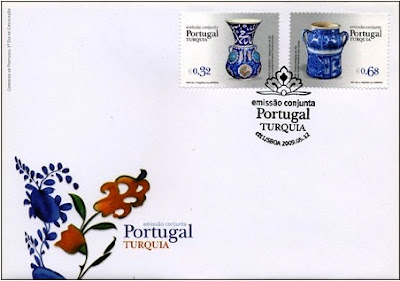
Hi ! Here is a beautiful pottery art work depicted on recent issue by Potugal. It is joint issue of Portugal and Turkey.This issue seeks to build a cultural bridge between Portugal and Turkey through pottery. This art, which is common to the Portuguese and to the Turkish peoples and which dates back to the dawn of the civilization, reveals through its evolution the various influences that the intercultural relations have suffered, as well as these peoples continuous assimilation and reinterpretation in search of their own ways of expression.The two porcelain pots shown on stamps depict magnificent art work. The design of both stamps and FDC de is very nice and sure to be liked by art lovers. This is all for today !....Till Next Post.....Have a Nice Time !


Joint Issue Portugal – Turkey
Oriental porcelain, especially Chinese porcelain, has always been highly valued in many parts of the world. After the discovery of the ocean route to India, porcelain became much more accessible and found its way to religious services and to the best homes, replacing silverware which had been used until then.


One of the images that form part of this issue shows a graceful mosque lamp in Iznik earthenware from the 16th Century. On its neck some Arabic characters can be seen, most likely excerpts from a religious text. On the belly, decorated with cobalt blue, turquoise, green and red vegetalist motifs, three suspension rings are designed.

Another image shows a beautiful cylindrical jar with handles, a Portuguese earthenware item produced in the early 17th Century. Painted in blue, the decoration is based on geometric and vegetalist stylized motifs, displaying on the neck the famous “baroque volutes”.

Sunday, April 19, 2009

New Stamp from Portugal.....


Eight hundred years of Franciscan Order
Date of Issue - 11 March 2009


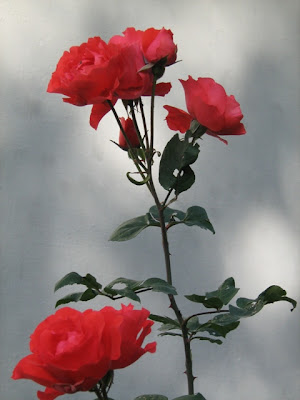
Hi ! In today's post here is the recent stamp issued by Portugal on 11 March 2009 "Eight hundred years of the Franciscan Order". What attracted me to make this stamp for today's Post is the lovely innocent dog shown on this stamp. Though the stamp is on religion theme and related with the history of Portugal. But this nice stamp can also be included in pet's theme. As I have my own pet dog I am always fascinated to see this innocent creature on stamps though I have not yet prepared a collection on this Man's best friend. To show my love for dogs I am giving here this nice stamp. The stamp shown above has its own history that I am giving below along with the beautiful miniature sheet and FDC issued with this stamp. In the second part of this post some lovely roses which have bloomed these days in my garden. They look so beautiful with the onset of summer season in Kullu. These images are not related with philately, but I just want to share the beauty of these roses which appear on nice images of Roses taken today with all of you as Rose is a flower which attracts every one. But its unfair to put here these images without a philatelic item. So I am showing here a Rose aerogramme of Australia from my collection with the images of Roses from my garden. This is all for today !.....Till next Post ....Have a Nice Time !....


Eight Hundred Years of the Franciscan Order
When turning 25, Francis Bernardon, who had been born in the wealthiest family in Assisi, came to the conclusion that happiness and freedom could only be authentic when inspired in evangelical poverty. And he acted accordingly. With such conversion, the young of Assisi attracted his former companions to his new way of life, and gather twelve followers around the same ideal. In 1209, they all travelled to Rome to beg of Pope Innocent III the approval of their way of life, confirmed in 1223 by Honorius III Bull. The religious institute was henceforth called the Order of the Friars Minor (OFM).

A few years later, in 1212, Clare of Assisi, a noblewoman, tempted by the achievement of her fellow citizen Francis, founded the Order of Poor Ladies. She too succeeded in requesting and gaining the “Privilege of Poverty” from the Pope, through a Rule approved in 1253, although the approval was only achieved on the eve of her death. Thus the Order of Saint Clare (OSC) was created.

In the year 1214, and in view of the growing devotion among the Christian people towards the innovative modality of this evangelic way of living, Francis wrote a letter to all the faithful, inspiring the creation of the Secular Franciscan Order (SOF), which first Rule was approved by the Holy See in 1289. In the 15th century, a movement of life in community, with both male and female branches, grew out of the Third Order. From this movement emerged, in 1521, the Rule of the Third Order Regular (TOR).

The Friars Minor came to Portugal around 1216. One of their first and most notable conquests was Saint Anthony of Lisbon (a. 1190-1231), who found enormous richness in the poverty of the Friar Minors. In 1258, the Nuns of the Order of Saint Clare also settled here, initially in the city of Lamego, but transferred shortly afterwards to Santarém. Also the Third Order of Penitence, founded to congregate all the laypeople who wished to follow the example of Saint Francisco, was exceptionally well accepted by all social classes since the 13th century.

When the Liberal Government decided, in 1834, to extinguish all the Regular Orders, the Order of the Friars Minor held more Religious Houses than all the other Orders together, on the Portuguese Mainland, on Madeira and on the Azores alone.

From 1834 to 1940 the Franciscans remained clandestine, although they continued to work in Portugal as much as they could. In 1891 they restored the Province of Portugal, from the Varatojo Convent. The branch of the Capuchin Friars Minor returned to Portugal in 1939 and the branch of the Friars Minor Conventual a few years later, in 1978. Also the Clarisse Sisters were able to re-emerge, in particular in the 1950’s. The Secular Franciscan Order, precisely because it was secular, was not extinguished in 1834 whereby it could act as an important support to the “egress” friars. The male TOR was not restored, but the female TOR multiplied after 1871, when several Franciscan Sisters’ Congregations of Consecrated Life were created.


Throughout its eight centuries of history, the Franciscan family has always been the one with the greatest number of members and of apostolate work, in Portugal as well as in the rest of the World.
Courtesy - Portugal Post


Thinking of you !

Roses in my Garden


Rose of all Roses, Rose of all the World!You, too, have come where the dim tides are hurledUpon the wharves of sorrow, and heard ringThe bell that calls us on; the sweet far thing. - William Butler Yeats


The red rose whispers of passion, And the white rose breathes of love;O, the red rose is a falcon,And the white rose is a dove. - John Boyle O’Reilly


Which is loveliest in a rose? Its coy beauty when it's budding, or its splendour when it blows? - George Barlow


“Take time to smell the roses"


The world is a rose, smell it and pass it to your friends. -Persian Proverb

Monday, March 9, 2009

About Art and Artist ....


Date of Issue - 27 January 2009


Hi ! In the morning post I wrote about the new stamp on science by Portugal. Here is a beautiful stamp depicting a painting by famous Portuguese artist, Henrique Pousão who died at the young age of 25 , he was a major figure in the history and culture of Portugal. The set of 2 stamps depicting art and the artist was issued on 27 January 2009 The stamp represents a painting ' Waiting for Success ' painted in 1882 depicts the inside of the painter’s studio, where the model, a popular figure of a Roman boy, shows a childish drawing during a break between posing. This work still possesses features that are strikingly academic, in terms of the composition structure though particularly rich in referents, which might suggest a more in-depth interpretation.Here are the beautiful stamps and FDC depicting an important figure from Portuguese history and culture. This is all for this Evening !....Till Next Post ....Have a Nice Time !.....


Henrique Pousão (1859 – 1884)
Henrique César de Araújo Pousão was born in Vila Viçosa on January 1, 1859. He was the son of a judge, Nunes Pousão. Due to his father’s profession, he lived in several cities before settling in the North of the country in 1872, where he began his artistic studies in the Fine Arts Academy of Porto (Academia Portuense de Belas Artes). Among his masters in the first years of his studies, António José da Costa, with whom he had private lessons, and João António Correia and Marques de Oliveira, at the Academy, stand out.In November 1880, after having won a few months earlier a state scholarship to study abroad, he left for Paris together with Sousa Pinto. He enrolled in the Fine Art Academy where he studied under the painters Cabanel and Yvon. He worked intensely during the first months, on small annotations and landscape studies.


The severe Paris winter soon proved inadequate for his feeble health. The following summer he travelled to the centre of France in search of a better climate and, at the end of the year, in December 1881, after applying for a transfer, he moved to Rome. Some of his most symbolic works are from this new phase. Another fundamental stage of Pousão‘s artistic path is linked to his stay on the island of Capri, which he visited during the time he lived in Rome, between June 1882 and September 1883. The Mediterranean light and the intense colours fill the studies to which the artist fastens pieces of landscape or plain street scenes. The advance of the disease forced him to return to Portugal. Pousão died of tuberculosis, in March 1884, at the young age of twenty five.

Courtesy - Portugal Post

Sunday, March 8, 2009

Aquihaselo - Science in Portugal ...


Hi ! Here is a very nice and beautiful stamp on Science issued by Portugal on 3 March 2009. On the first look it gives the appearance of some fresh red frruits but it actually depicts a highly scientific phenomenon . The design was selected by a competition of stamp designing in Portugal which is known as AQUIHASELO in Portuguese meaning hobby challenge. If someone is reading from Portugal please let me know the correct meaning of 'aquihaselo'.

About the stamp design :
The illustration on this stamp represents the active centre of an enzyme called CotA-lacase, which has been identified in the bacteria Bacillus subtilis; it has some very interesting features from the functional point of view, given its wide-ranging applications in the field of biotechnology. Besides its capacity to wear-down compounds produced during industrial processes, the so called highly pollutant phenols, this enzyme has a potential in bioremediation, in the formation of biopolymers (most commonly used in plastic manufacturing), in the processing of fruit juices, as biosensors, and in the wear-down of a vegetable fibre called lignin.On the stamp, different atoms in the enzyme’s activity centre have been coloured; among these, the central orange atom stands out; it represents the copper atom that enables the enzyme to function. In its role as a cultural and social disseminator, the stamp discloses an important scientific discovery which, after all, can also be an artistic representation.

Well this is the beautiful stamp on biotechnology . It will be very much appreciated by those collecting on Chemistry or other associated Science themes. This is all for this Morning !....Till Next Post...Have a Nice Time !