Showing posts with label QEII Brooches. Show all posts

Sunday, July 1, 2012

Sunday Brooch: The Jardine Star

The Jardine Star Brooch
On the Queen's list of favorite brooches is a traditional model we call the Jardine Star. It features 8 diamond rays separated by a single collet which fan out from a central cluster of a large diamond surrounded by 8 smaller stones.
What's known about this brooch's history comes from Leslie Field in The Queen's Jewels:
"In 1981 the Queen was left a late-Victorian diamond star brooch by Lady Jardine, which she has worn on many occasions. It has a collet diamond on a knife-wire between each of its eight points."
Further detail on Lady Jardine and what her connection or motivation might have been to gift the Queen with this brooch is omitted. There are a few Jardine Baronetcies and the wives of the baronets would be titled Lady Jardine, but which Lady Jardine is referenced here is unclear. A queen receiving a bequest of jewels from someone no matter the connection is not so unusual, of course; one example is the Greville bequest which provided many of the Queen Mother's favorite jewels.
The brooch in action, as the Queen addresses Parliament on the occasion of her Diamond Jubilee
Princess Anne owns a similiar piece, and there are plenty more star brooches out there that look like this one. Their all-purpose design never really goes out of style, as the Queen shows us regularly.

Photos: Corbis/Polfoto

Sunday, June 10, 2012

Sunday Brooch: The Guards' Badge

Within the vast brooch collection of Queen Elizabeth, there is a special subset of brooches that represent military entities. They usually depict the symbol of the military group in question, and are most often given by the group to the queen. Many royal ladies have brooches, or badges, like this: we’ve seen the Duchess of Cambridge represent the Irish Guards and the Royal Navy Submarine Service and the Duchess of Cornwall wear a brooch from the Queen's Own Rifles of Canada lately, for example. The queen certainly has the largest collection of these badges of all the royal ladies, and she has one unique and large badge that gets a special annual outing.
The Guards' Badge
Known as the Guards’ Badge, this particular brooch combines the badges of the five Household Regiments: the Grenadier, Coldstream, Scots, Irish, and Welsh Guards. Rendered in diamonds and topped by a crown, the five symbols are enclosed in an oval frame bearing the words QUINQUE JUNCTA IN UNO, meaning “five joined as one”.
The pendant given to Princess Mary and the symbols represented: (top row, left to right) the Grenadier Guards, the Welsh Guards, the Coldstream Guards, (bottom row) the Scots Guards, the Irish Guards
Princess Mary, daughter of King George V and Queen Mary, was presented with a pendant of this design from Garrard by the Brigade of Guards for her wedding in 1922 (shown above). Queen Mary wore this design as a brooch, and Queen Elizabeth does the same. It seems a good bet that the one seen on Queen Mary, at least, is the one now worn by the current queen, if all three are not the same; either way, it is clear that this symbol has a long history with royal ladies.
This brooch is worn annually for Trooping the Colour, the sovereign’s annual birthday parade. Her Majesty’s actual birthday is on April 21st, but she follows the long tradition of celebrating it publicly on a Saturday in June, when there’s a better chance for good weather. Since 1748, this celebration has been Trooping the Colour. The ceremony stems from the tradition of carrying (or trooping) the colour (or flag) of a battalion down the ranks of its troops so that it could be seen and later recognized on the battlefield by the soldiers. It is performed by fully trained and operational troops from the Household Division.
Queen Elizabeth travels from Buckingham Palace to Horse Guards Parade for the ceremony (she rode on horseback in uniform until 1986, after which she began riding in Queen Victoria's 1842 ivory-mounted phaeton). She is preceded by carriages carrying a selection of senior royals, and is followed by the Royal Colonels (the Duke of Edinburgh, Colonel of the Grenadier Guards, in the carriage with her; the Prince of Wales, Colonel of the Welsh Guards, the Duke of Kent, Colonel of the Scots Guards, the Duke of Cambridge, Colonel of the Irish Guards, and the Princess Royal, Colonel of the Blues and Royals, on horseback behind her). After the ceremony she returns to the palace, takes a salute while standing on a dais outside, and then joins her family on the famous balcony to watch a fly-past from the Royal Air Force. She has attended every year of her reign except for 1955, when the festivities were cancelled due to a national rail strike.
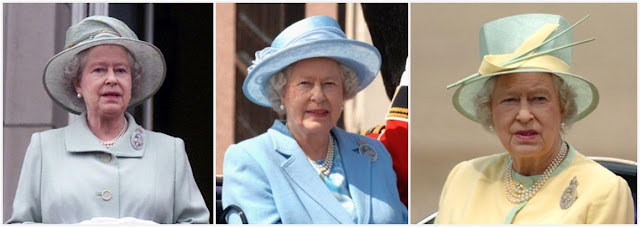
When the queen stopped riding in the parade, she stopped wearing her uniform and started wearing her standard day wardrobe. That meant a brooch was required; a few years after the switch, she settled on the Guards’ Badge and she’s worn it every year since. It’s really the perfect option for this event: the same 5 regiments represented here are the ones that take turns each year trooping their colours for her. Wearing this badge provides a special connection to each one, every year.
Unlike most brooches, those that fall under the regimental badge category are not worn for looks. They aren’t worn to complement an outfit; they’re worn as a special symbol between the royal and the regiment. And as we’ve seen in this jubilee year, the bond between Her Majesty and her troops is especially strong.

If you’re interested in viewing Trooping the Colour this year (2012), it will be held on Saturday, June 16th. The BBC broadcasts the ceremony live, starting at 10:30 a.m London time this year on BBC One in the United Kingdom.

Photos: Getty/Corbis/British Army/Illustrated London News

Sunday, May 27, 2012

Sunday Brooch: Queen Victoria's Diamond Jubilee

A Diamond Jubilee brooch for a Diamond Jubilee year today.
Queen Victoria's Diamond Jubilee Brooch
Among the presents received by Queen Victoria for her Diamond Jubilee in 1897 was a brooch from current and former members of her personal staff. Made by Garrard, the sizeable brooch features scrolls of diamonds around a large central pearl. The bottom chain of brilliants and pearl pendant are detachable.
Queen Elizabeth, the Queen Mother
Queen Victoria was delighted with her Household's gift - delighted enough to designate it as Crown property. Passing from queen to queen, it ended up in the hands of Queen Elizabeth, consort George VI and the future Queen Mother. It became one of her favorite brooches and was worn frequently; notable wearings include an outing for the 1947 wedding of her daughter Princess Elizabeth.
Queen Elizabeth II
The Queen Mother held on to this brooch until her death in 2002, at which time it passed to her daughter, Elizabeth II. The current queen has worn it just a few times since then, prefering to remove the bottom chain for day engagements and adding it back in for one evening outing. I'm quite surprised we haven't seen yet this year, being the queen's Diamond Jubilee year and all. Perhaps we'll see it this coming weekend, for the main jubilee celebrations?

As a side note, Queen Elizabeth has received at least two brooches so far this year to commemorate her own Diamond Jubilee.
Left, the Canadian regimental tribute; right, the Chelsea Flower Show brooch
The Royal Regiment of Canadian Artillery gave their Captain-General a gold and platinum brooch featuring their regiment's symbol over a maple leaf with a "60" in the center. The brooch has 60 diamonds as well as a sapphire, emeralds and rubies. Recently, the Royal Horticultural Society presented her with another special jubilee trinket at the Chelsea Flower Show: a £40,000 white gold iris brooch with a large yellow diamond in the center, 60 sapphires, 15 diamonds, 20 amethysts, and 30 tourmalines. We've yet to see her wear either; a safe bet would be her next engagement with the Royal Regiment of Canadian Artillery and next year's visit to the Chelsea Flower Show.

Photos: The Royal Collection/Corbis/Daylife/Royal Regiment of Canadian Artillery/Kristjan Eyjolfsson

Sunday, May 13, 2012

Sunday Brooch: The Centenary Rose

What does one brooch-loving queen get another brooch-loving queen for her big birthday? A brooch, of course!
The Centenary Rose Brooch
For the perfect trinket to mark her mother Queen Elizabeth the Queen Mother’s 100th birthday, Queen Elizabeth II turned to G. Collins & Sons jewelers in 2000. The result was this brooch, the Centenary Rose: a pink Queen Elizabeth rose hand-painted and carved in reverse intaglio in rock crystal set in a frame made with 100 brilliant-cut diamonds.
The Queen Mother
Sadly, the Queen Mother didn’t have a tremendous amount of time to enjoy her gift: she died in 2002 at the age of 101.
Queen Elizabeth
On her death, the brooch came back to the queen, and it’s since made quite a few appearances. Being a gift she herself commissioned, it’s not hard to see both the sentimental and aesthetic appeal here for her.
Queen Elizabeth
In fact, she was so pleased with the design that Collins & Sons ended up her personal jeweler, a Royal Warrant holder and in 2007 Harry Collins replaced Garrard as the official Crown Jeweler – a position held by Garrard since 1843. (Collins gave up the post and Martin Swift of Mappin & Sons silversmiths was appointed in July of 2012.)
Queen Elizabeth wore the brooch for her 2002 Christmas message - her first since the passing of her mother and sister. Pictures of her mother, father, and sister are next to her.

Photos: Daylife/Corbis/BBC/PA/Polfoto

Sunday, May 6, 2012

Sunday Brooch: The Flower Basket

As Princess Elizabeth, the queen's jewelry collection was a largely personal one: mostly gifts from her wedding, birthday presents, and trinkets marking other significant events. Today's brooch is one such gem.
The Flower Basket Brooch
This brooch depicts a basket filled with ruby, diamond and sapphire flowers and was given to Princess Elizabeth by her parents, King George VI and Queen Elizabeth, to mark the birth of Prince Charles in November 1948.
With Charles
She wore it for the Charles' first official pictures about a month later, and she still wears it today. We've seen so far in our series that Queen Elizabeth has a tendency to match her colored stone brooches to her clothes in a rather literal fashion, but the many colors in this brooch make it game to be worn with a whole rainbow of outfits.
I always think the success of these multicolored brooches comes down to what color you pin them on: when the color's just right, they are so vibrant, but when it's wrong, the colors just fall flat.
This one's particularly good on red, don't you think?

Photos: Royal Collection/Queen Elizabeth II/Daylife/Getty Images

Sunday, April 29, 2012

Sunday Brooch: The True Lover's Knot

You aren't too tired of Queen Mary's taste in diamonds coming off a week of Cullinans, are you? I hope you have room for one more, as it only seemed fitting to showcase this brooch on April 29th.
Queen Mary's True Lover's Knot Brooch
Of all the bow brooches in the queen's collection, this is the biggest and fanciest. Naturally, she has Queen Mary to thank for that; Mary acquired the brooch from Garrard in the early 1930s.
Queen Mary
The brooch features brilliant cut diamonds set in silver and gold tied in a "lover's knot". The scalloped ribbon has joints on each of the "tails" to allow the ends to move. It was among multiple bow brooches (the Royal Collection reports 5, Hugh Roberts reports 6) in Queen Mary's collection, and was left to the current queen on Mary's death in 1953.
Queen Elizabeth
Being so large and so sparkly, we usually see this one in the evening. It does its duty anchoring sashes and so forth. And when we see it in the daytime, it feels like a special treat.
Queen Elizabeth
Notable day showings include a stint anchoring poppies on Remembrance Day (left, above) Princess Margaret's wedding (center) and its most famous appearance to date at Prince William's wedding (right), one year ago today.


Photos: Leslie Field/Daylife

Wednesday, April 25, 2012

The Cullinans, Part 4: The Pendant Brooch

Next up in our review of what’s become of the Cullinan Diamond is a brooch that packs a double Cullinan punch.
The Cullinan VI and VIII Brooch
The top part of this brooch includes Cullinan VIII, an emerald-cut 6.8 carat diamond. One of the South African government's gifts to Queen Mary, she set it in a diamond surround very much like that of the Cullinan V - and just like its heart-shaped friend, Cullinan VIII was also a part of Mary's emerald stomacher.
Mary's emerald stomacher, with Cullinan VIII - the emeralds above and below form a brooch on their own when not in this stomacher
For a purely diamond version, Mary suspended a marquise-cut diamond below. This, of course, was yet another Cullinan chip.
Queen Mary with the diamond version - sometimes forming a mini-stomacher along with the Cullinan V Brooch
According to the Royal Collection, who have exhibited this brooch in the past, the diamond pendant is Cullinan VI. Some sources say it was Cullinan VII instead, which is a slightly smaller marquise diamond. Mary did indeed use Cullinan VII occasionally as the pendant to Cullinan VI. (More on VII here.)
Queen Alexandra with Cullinan VI set in her circlet
At any rate, Cullinan VI is the one Cullinan  piece that King Edward VII bought from Asscher's as a personal gift for his wife, Queen Alexandra. She set the 11.5 carat marquise diamond in the front cross of her Regal Circlet. This too ended up with Queen Mary and the rest of the Cullinans.
Queen Elizabeth
And now, as with the rest, it is with Queen Elizabeth, who inherited the brooch on Mary's death in 1953. She doesn't wear it too often, but every time she does I can't help but think it's much smaller in real life than I expect it to be.


Photos: Royal Collection/Queen Elizabeth II/Leslie Field/Corbis

Tuesday, April 24, 2012

The Cullinans, Part 3: The Heart-Shaped Brooch

Today’s entry in the saga of the Cullinan diamonds might not be the most famous one, but it gets more use than any of the rest.
Cullinan V Brooch
Cullinan V is an unusual heart-shaped diamond of 18.8 carats, set in a diamond and platinum surround intended to emphasize the heart shape. Like III and IV, the diamond was a gift from the South African government to Queen Mary.
Queen Mary wearing the brooch (left) and using it as the center of her emerald stomacher (center and right)
Mary used the brooch on its own, but also designed it to go in the center of the large emerald and diamond stomacher made to add to the parure of emeralds she had with emeralds received from India to commemorate the Delhi Durbar in 1911 and the Cambridge emeralds she inherited from her family.
The brooch in the circlet, 1937 coronation
The heart-shaped brooch also did a stint in the circlet created by removing the arches from Queen Mary’s crown; it took the place of the Koh-i-Noor, which Mary gave to the new Queen Elizabeth to use in her crown for the 1937 coronation. And it had a second diadem use too: it fit into the center of the honeysuckle tiara now in the possession of the Duchess of Gloucester.
Queen Elizabeth
The brooch was part of the current queen’s inheritance when Mary died in 1953. Not one for stomachers, she uses it in her traditional brooch fashion.
Queen Elizabeth
This is one of the queen's favorite brooches - which is why I say it gets more use than the rest of the Cullinan diamonds. It may not be as big as Granny's Chips, but wearing an 18.8 carat around is not too shabby either.


Photos: Leslie Field/Corbis/Daylife

Monday, April 23, 2012

The Cullinans, Part 2: Granny's Chips

Apart from the stones set in the Crown Jewels, these two diamonds – known as Cullinan III and IV, or the Third and Fourth Stars of Africa, or just “Granny’s Chips” (more on that nickname in a bit) - are the most famous Cullinan chippings.
The Cullinan Brooch
Cullinan III is a pear-shaped 94.4 carat diamond and is suspended from Cullinan IV, a square-cut 63.6 carat diamond, in the famous silver Cullinan Brooch setting. They were both given to Queen Mary in 1910 by the South African government, along with Cullinans V and VII through IX, and the rest of the miscellaneous leftover chippings. As I mentioned before, these stones were initially left with the Asscher company as a fee for cutting down the Cullinan Diamond, and new government of the Union of South Africa bought them and gave them back to Mary.

Queen Mary loved her Cullinan chips, these two perhaps most of all. I know I say it over and over again, but she really was one of the most creative royals when it came to jewels, and that is never more evident than when you look at what she did with these two large diamonds.
Queen Mary with various uses of these two diamonds
Spotting Cullinans in photos of Mary is essentially a sparkly version of Where’s Waldo? In the above pictures starting from the left, III and IV were temporarily set in the new crown she had made for herself for her 1911 coronation alongside her husband, George V (the pear diamond was mounted upright on the top cross, while the square diamond was nestled front and center on the base of the crown). She also mounted both or just one in the Delhi Durbar Tiara made for her for the Indian celebration of her husband’s accession; she occasionally replaced the Lahore Diamond pendant on the Coronation Necklace with both or just one of the stones; and at least once, she used III as a diamond pendant on her Ladies of India emerald necklace.
Queen Mary with the brooch
But the most famous use of these two Cullinans is in that brooch – so simple, yet so huge. Mounted front and center on Mary’s outfits, in this setting these diamonds saw all the important family events, including her children’s weddings and Princess Elizabeth’s wedding, plus the 1937 coronation and more.
Queen Elizabeth
All of the smaller Cullinans (everything except I and II) were kept by Mary until her death in 1953, when they passed to the current queen. She hasn’t moved them these two out of their brooch setting, and has only used the jewel a handful of times. She has, however, given this brooch (which can simply be called the Cullinan Brooch) its amusing nickname. "Granny's Chips" is sometimes used to refer to all of the Cullinan chippings, but specifically it's about this brooch.
Queen Elizabeth at Asscher's in 1958
While on a state visit to the Netherlands in 1958, Queen Elizabeth visited Asscher’s, the site of the initial Cullinan cutting. Present for the visit was Louis Asscher, who had witnessed the cutting of the great diamond in 1908. The queen wore the huge brooch for the visit, and as she removed it so Mr. Asscher could have a better look - a gesture which was said to have reduced him to tears - she was overheard casually referring to it as “Granny’s Chips”. You know, because 158 total carats isn’t really that big of a deal. (I suppose, compared to the brooch you can make out of Cullinans I and II, "chips" seems appropriate.) Click here to see the sparkle of Her Majesty's 1958 visit.


Photos: Mirror/Corbis/Leslie Field

Sunday, April 15, 2012

The Queen's Top 10 Diamonds: #8. The Australian Wattle Brooch

Fresh off the success of 1953’s coronation, Queen Elizabeth and the Duke of Edinburgh embarked on an ambitious world tour to introduce the Commonwealth to its new queen. When she made it to Australia in 1954, she became the first reigning sovereign ever to visit. Australia welcomed its new queen with open arms…open arms and jewels.
The Australian Wattle Brooch
The Australian Wattle Brooch takes a floral approach to flying the Australian flag. Yellow diamonds depict sprays of wattle, the national flower. The wattle gives the brooch its name, but there's more flowery goodness going on: diamonds with a slightly blue color signify mimosa leaves, forming a background for diamond tea tree blossoms (each with a single large white diamond in the center).
Wearing the brooch during the 1954 tour, at the Flemington races
The wattle brooch was a state gift from the people and government of Australia. It was designed and crafted by Paul Schneller, a jeweler born in Budapest, and commissioned by William Drummond & Co. The gift was presented to the queen during a banquet in Canberra, and she wasted no time wearing it during the same tour.
She’s worn it ever since, and not just when going about Australian business. Many of the brooches in the queen’s collection with special connections to a country or a group are brought out when the connection requires it, like we saw with the Maple Leaf Brooch. This one gets every day outings too.
Any jewel given from a country to its sovereign automatically holds a special significance. And for Her Majesty, brooch lover extraordinaire, a brooch gets an extra dose of importance. Among the Commonwealth brooches the queen has, this one made my list over all others for a few reasons: it’s enormous and loaded with diamonds, it was made specifically for her and is a special symbol of her personal relationship with Australia, and she actually seems to like it. Bonus points all around.
Wearing the brooch in Ireland


Photos: Queen Elizabeth II/The Royal Collection/Daylife

Friday, April 13, 2012

The Queen's Top 10 Diamonds: #10. Victoria's Fringe Brooch

History and carat weight are both going to factor heavily into this countdown, and our starter piece has both in spades.
Queen Victoria's Fringe Brooch
Queen Victoria's diamond fringe brooch (alternately referred to as a waterfall or tassel brooch) has all of these qualities in abundance. The piece includes a huge emerald-cut diamond surrounded by brilliants with an outer row of 12 large diamonds. From this, 9 swinging strings of diamonds are suspended.
Queen Victoria
It was made for Queen Victoria in 1856, when Garrard remodeled an existing jewel from her collection to add in diamonds she received as a gift from the Sultan of Turkey earlier that year.
Queen Alexandra (left and center), Queen Mary (right)
It's been worn by all queens since Victoria: next was Queen Alexandra, and after her, Queen Mary. After King George VI acceded the throne, this brooch was among the jewels Mary handed over to her daughter-in-law (and new queen) Elizabeth. The future Queen Mother made frequent use of the brooch, giving it a spotlight unseen in its history: on her, the brooch saw events like the 1953 coronation of Elizabeth II and the wedding of Charles and Diana in 1981.
Queen Elizabeth, the Queen Mother
This brooch was really designed to be worn at the bodice of a dress, to complement the low necklines popular at the time of its creation. The Queen Mother also wore it up on her shoulder as she traditionally wore her brooches, though less successfully as the long strings were prone to getting jumbled or slanting to one side.
Queen Elizabeth II
The brooch passed to the current queen when the Queen Mother died in 2002, and she's worn it once since (that we know of): for the state visit from Turkey, appropriately. She even wore it as it was intended to be worn, at the center of her neckline. This sparkly brooch will be included in the exhibition of the queen's diamonds at Buckingham Palace this summer.

It's not the biggest brooch in the collection, this is true. But it's seen its way through four generations and counting, and it's got enough heft to come in at number 10 in my countdown.


Photos: Queen Elizabeth II/The Royal Collection/Corbis/Daylife

Sunday, April 1, 2012

Sunday Brooch: The Maple Leaf

As we know, Queen Elizabeth's brooches often offer more than just pretty bling to look at; they're often symbolic as well. This is very true when it comes to the brooches in her collection the represent her Commonwealth realms.
The Maple Leaf Brooch
This diamond brooch in the shape of Canada's instantly recognizable maple leaf was given to Queen Elizabeth, the future Queen Mother, by her husband George VI in advance of their wildly successful Canadian tour in 1939.
Queen Elizabeth the Queen Mother
The sizeable gem was a particular favorite during the war years, when she'd even perch it jauntily on her hat from time to time. She kept it until the end of her life, when it passed to the current queen like the rest of her jewels. We now see it pop up in Canada and at Canada-centric activities.
Queen Elizabeth II
The Windsors are not generally a family that does a lot of jewel sharing, which makes this brooch an interesting case. Queen Elizabeth first wore it in 1951, when her mother lent it to her for her first tour of Canada alongside her husband, the Duke of Edinburgh, and she's now carried that tradition forward.
The Duchess of Cornwall
She loaned the brooch to the Duchess of Cornwall for her first tour of Canada with the Prince of Wales in 2009, and Camilla wore it several times during the trip.
The Duchess of Cambridge
The queen did the same thing in 2011, lending it to the Duchess of Cambridge for her first Canadian visit with her husband. The Duchess wore it on two separate outfits on Canada Day and again when departing the country.
A bit of sparkle in motion

It was not lent again to Camilla for her second Canada tour, for the Diamond Jubilee in 2012, so it may just be a treat for one's first Canadian trip only.


Photos: The Royal Collection/Queen Elizabeth II/Leslie Fields/Corbis/Daily Mail/Getty Images/Zimbio/Daylife